Moment Graphing is live for the 2026–27 season. See the platform →
FanEase  /  Case study

Two revenue lines
from footage they already owned.

A top-flight North American soccer club made money twice on the same match content — once from the sponsor who paid to sit inside the video, and again from the fans who bought what they saw.
82%
Watch ratio
Fans stayed for the majority of the match, so the moments were seen rather than scrolled past.
13.2%
Store click-through
Of viewers who watched who clicked through to the club store. The highest rate we have recorded.
$25,000
Sponsor fee
Charged to one in-video sponsor for the season. Inventory that did not exist before.
The challenge

The moment, the sale and the data lived in three different places.

The club had the audience and the archive. What it did not have was a way to turn a moment into a transaction without sending the fan somewhere else.

Every match produced hundreds of moments a fan would act on — a goal, a debut kit, a player celebrating in gear that was on sale that week. All of it sat in footage the club already owned and had already paid for.

But the path from watching to buying ran off the club's own property. A fan would see something, leave, and complete the purchase on a platform the club did not control. The sale happened. The data did not come back.

Producing shoppable content manually was never realistic. It would have meant a person watching every clip, tagging every product, and publishing every version — for content that has a shelf life measured in hours.

Before the moment existed, there was nothing to sell inside the video.
The finding that reframed the engagement
What we ran

One model, one channel, and no producer in the loop.

FanEase read the club's match content, recognised kit, roster and catalogue inside it, and published moments back into the club's own channels.

No tagging step, no new production tool, no rebuild of the workflow. The club gave us access to the footage, a catalogue feed and a roster. Everything after that ran automatically.

The output was not an ad. It was a moment — a recognised instant in the video with something attached that a fan could act on, published back where the club already had the audience.

app.fan-ease.com Live
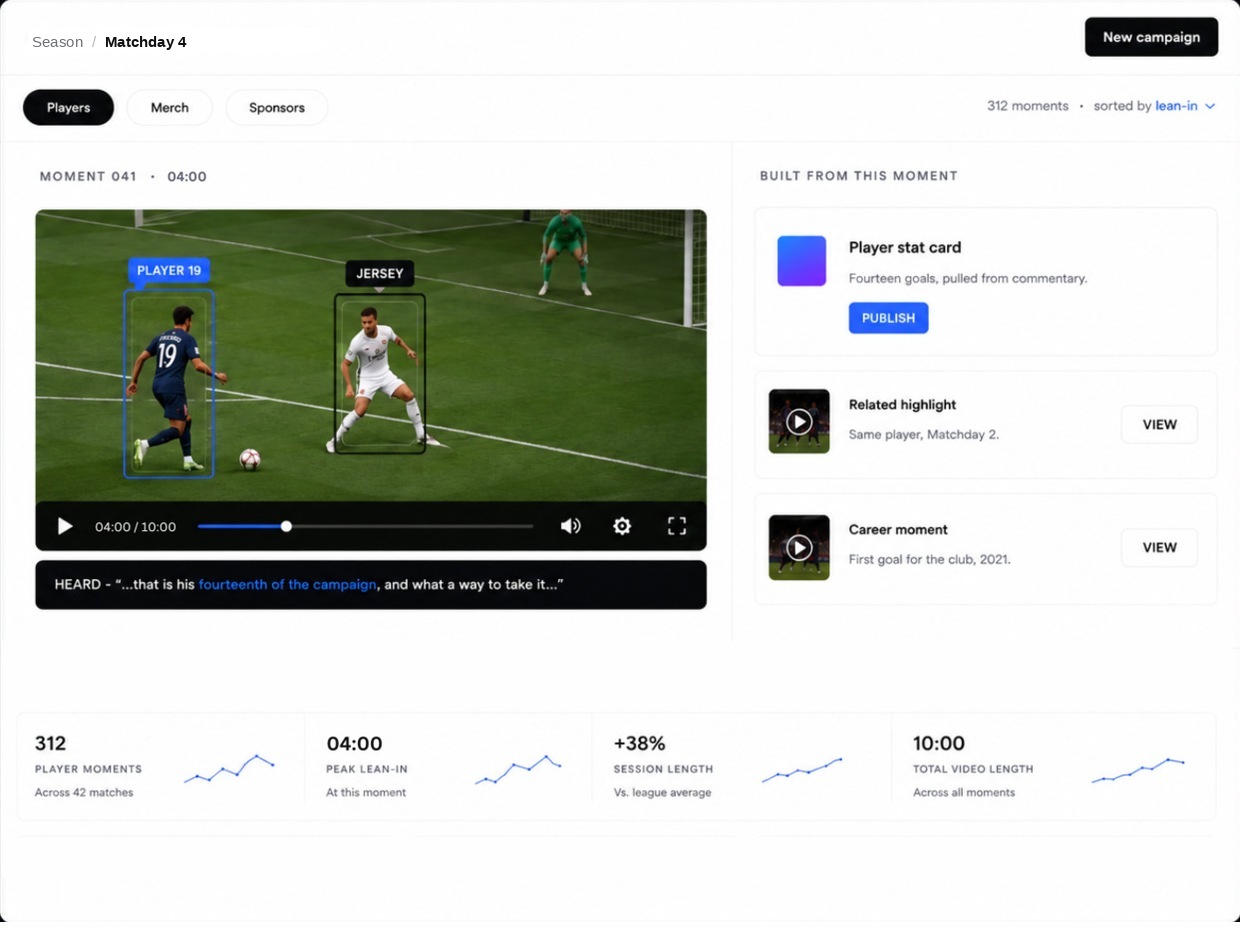
Player and kit recognition across match content
Moment detection · the stat card is built from what the commentary said, not from a feed.
app.fan-ease.com Live
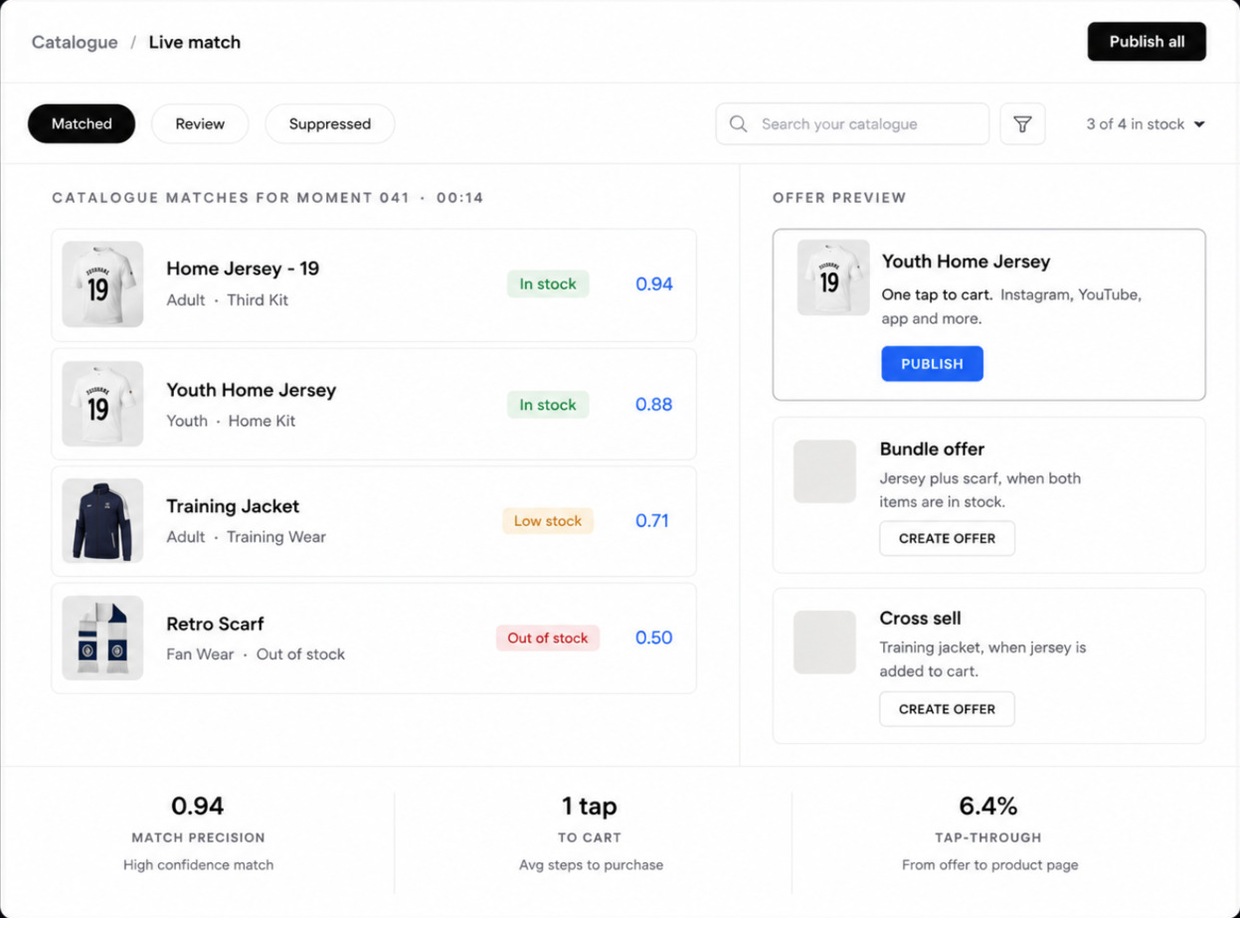
Catalogue matched to on-screen product
Catalogue · matched against live inventory, with out-of-stock suppressed automatically.
app.fan-ease.com Live
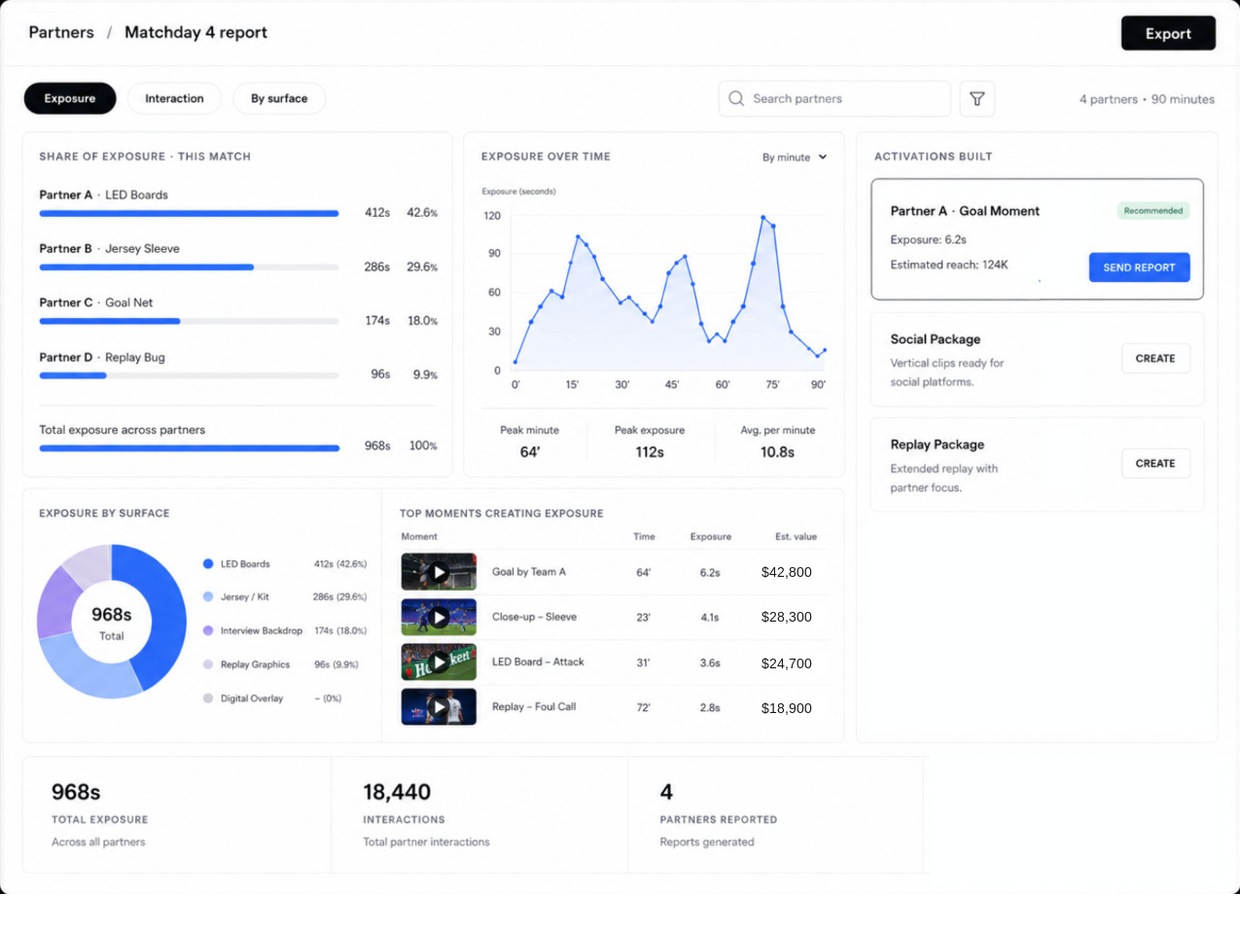
Partner exposure reporting
Partners · exposure and interaction land in a sponsor report without anyone counting frames.
The results

Two revenue lines, from footage they already owned.

The sponsorship fee is a third of the total. It is also the line that required no fan to do anything at all.
ResultFigureWhat it means
Time spent in a moment19.4 secNineteen seconds exploring kit, player gear and featured product. A considered look, not an accidental tap.
Store visits10,824Per 100,000 views.
Merchandise and ticketing sold$47,626Per 100,000 views, at an average order of $110.
In-video sponsorship$25,000What the club charged one sponsor to appear inside the moment, for the season. Sold once, billed once, no media spend attached.
Total revenue$72,626Per 100,000 views. The sponsorship fee is a third of it.

Seven sponsors covers the season. Against a two-model engagement at $30,000 a month, seven in-video placements at the club’s own rate pays for six months.

The merchandise then runs on top. At 250,000 views a month that is $119,065 every month, against a $30,000 engagement.

Keep reading

Related case study

Start selling the moment.